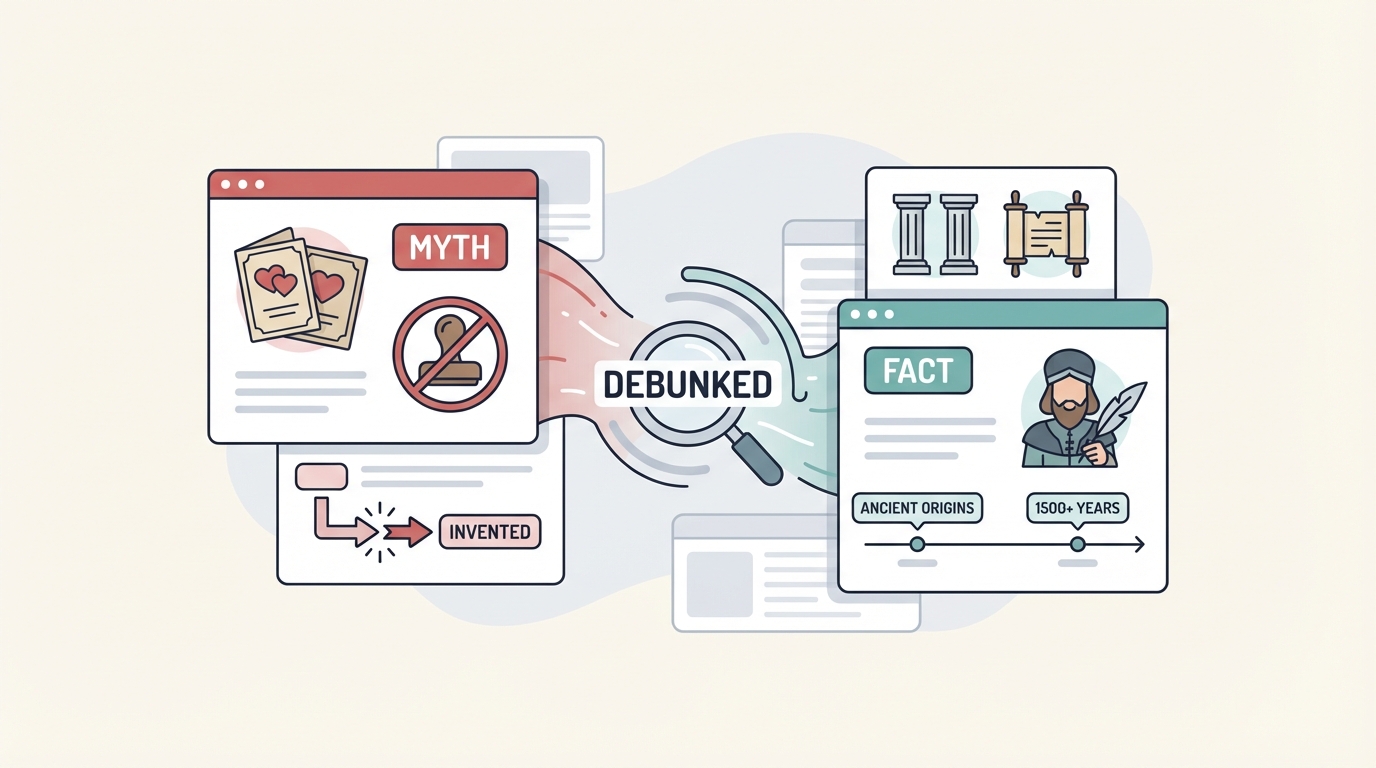
Every February, social media lights up with the same cynical take: Valentine’s Day is just a “Hallmark holiday” invented by greeting card companies to sell more cards. The idea gained real cultural traction after Jim Carrey’s character in the 2004 film Eternal Sunshine of the Spotless Mind declared it a holiday “invented by greeting card companies to make people feel like crap.”
It feels true, doesn’t it? Walk into any shop in early February and you’re assaulted by seas of red and pink, heart-shaped everything, and enough sentimental verse to fill a library. The commercialisation is undeniable. But here’s the thing: the myth that greeting card companies invented Valentine’s Day is exactly that, a myth. The holiday’s roots go back centuries, long before the first commercial valentine rolled off a printing press.
That doesn’t mean card companies are innocent bystanders. They didn’t create Valentine’s Day, but they definitely amplified it. The real story is more interesting than a simple conspiracy theory. It’s a tale of ancient Roman festivals, medieval poetry, Victorian entrepreneurship, and yes, 20th-century marketing muscle.
The myth that won’t go away
Let’s start with why this myth feels so plausible. Valentine’s Day is big business. In the UK alone, we spend around £926 million celebrating the occasion, purchasing roughly 140 million Valentine’s cards each year. Globally, it’s the second-largest card-sending holiday after Christmas, with an estimated 145 million cards exchanged annually in the US alone.
When you see those numbers, it’s easy to assume the whole thing was cooked up in a boardroom somewhere. Add in the fact that we can’t seem to agree on where the holiday actually came from, and the “greeting card conspiracy” starts looking like the simplest explanation.
But simple isn’t the same as true. Valentine’s Day has been celebrated in various forms for over 1,500 years. The greeting card industry as we know it didn’t exist until the mid-19th century. That’s a gap of more than a millennium. So where did Valentine’s Day actually come from? Let’s break it down.
Ancient origins: Rome, saints, and questionable history
The most commonly cited “origin story” connects Valentine’s Day to Lupercalia, an ancient Roman fertility festival held annually on 15 February. The rituals were… memorable. Priests would sacrifice a goat and a dog, then run through the streets of Rome slapping women with strips of the blood-soaked animal hides. This was believed to promote fertility and ensure healthy childbirth in the coming year.
About 496 AD, Pope Gelasius I banned Lupercalia and established Saint Valentine’s feast day on 14 February instead. Many historians have tried to connect the two, suggesting the Church Christianised an existing pagan festival. But modern scholars aren’t convinced. As Krešimir Vuković, author of Wolves of Rome: The Lupercalia from Roman and Comparative Perspectives, explains: “The connection between the Lupercalia and Saint Valentine’s day is a modern invention and relies solely on the accidental proximity of the two holidays in the modern calendar.”
So what about Saint Valentine himself? Here’s where it gets complicated. The Roman Martyrology, the official record of Catholic saints, lists at least three martyrs named Valentine, possibly as many as a dozen. Two of them were executed on 14 February, though it’s possible they were the same person.
The legends are romantic but historically shaky. One story claims Valentine was a third-century Roman priest who secretly married couples after Emperor Claudius II banned marriage for young men (single soldiers made better fighters, apparently). Another says he healed his jailer’s daughter of blindness and signed his farewell letter “from your Valentine.”
These tales emerged in the Middle Ages, centuries after the supposed events. As the late Professor Jack B. Oruch of the University of Kansas noted, “All the stories about St. Valentine are basically without any documentary evidence.” They were likely invented to get people interested in Christianity. The saint himself, if he existed as described, had nothing to do with romance.
Johnsons Cards has been part of the printing tradition since 1827, and we’ve seen how these historical narratives shape the products people want to create. Understanding the real history helps us appreciate the craftsmanship that goes into every card.
Geoffrey Chaucer: the real inventor of romantic Valentine’s Day
If Saint Valentine didn’t make the holiday romantic, who did? The answer, according to Professor Oruch’s extensive research, is Geoffrey Chaucer. Yes, the Canterbury Tales guy.
In 1382, Chaucer wrote a poem called Parlement of Foules (Parliament of Fowls). In it, he described birds choosing their mates on Saint Valentine’s Day: “For this was on seynt Valentynes day, Whan every foul cometh ther to chese his make.”
This reflected a medieval belief that birds selected their partners in mid-February. Before Chaucer’s poem, there’s no substantial evidence that anyone associated 14 February with romance. After Chaucer, the connection stuck. English nobility began sending love notes during “bird-mating season,” and the tradition slowly spread.
It took over 1,000 years after the executions of saints named Valentine for romance to enter the picture. Chaucer essentially invented Valentine’s Day as we know it, centuries before anyone thought to print it on a card.
The first valentines: from prison poems to printed cards
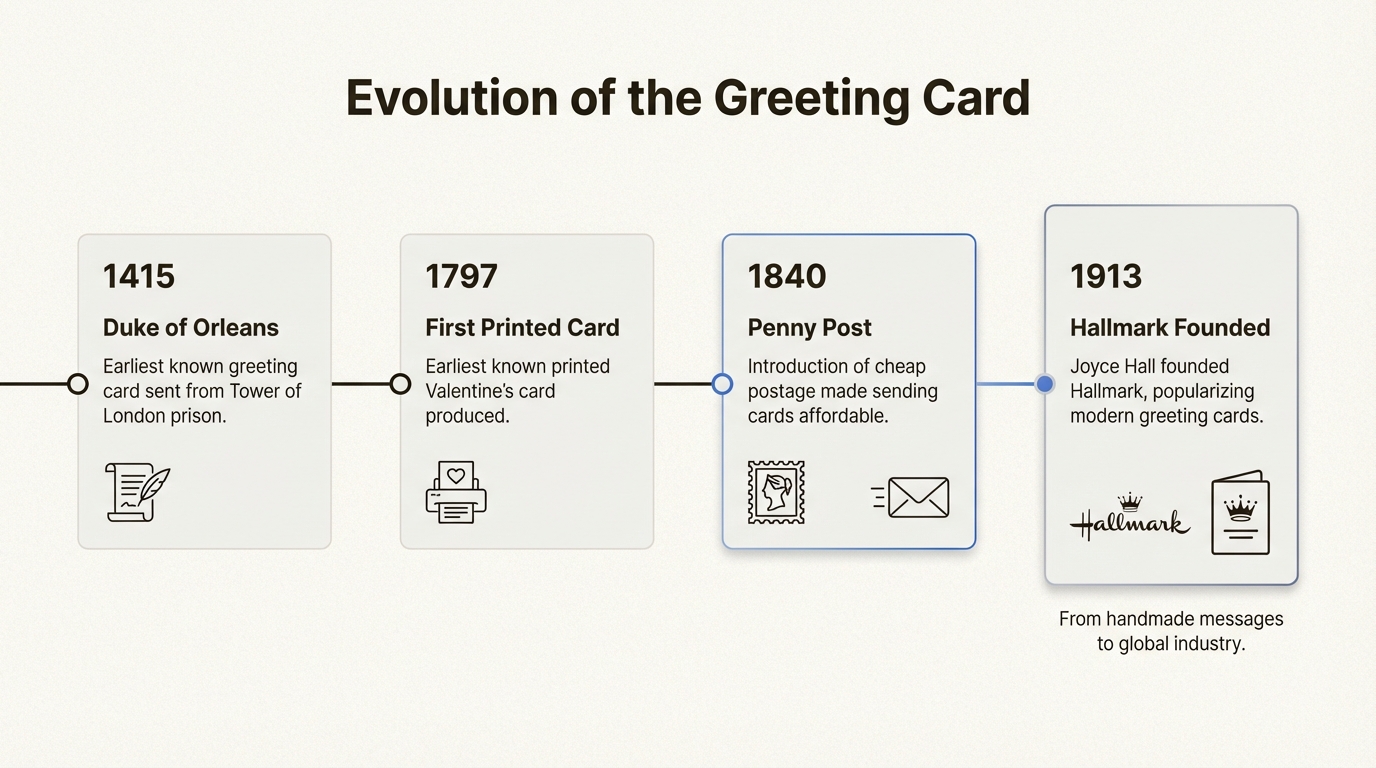
The earliest surviving romantic valentine was written in 1415 by Charles, Duke of Orleans. Imprisoned in the Tower of London after the Battle of Agincourt, he wrote to his wife: “Je suis desja d’amour tanné, Ma tres doulce Valentinée” (“I am already sick of love, My very gentle Valentine”). Tragically, she died before he was released. His poem now resides in the British Library.
By 1477, we have the earliest English-language valentine, written by Margery Brews to her fiancé John Paston. She called him her “right well-beloved Valentine” and begged him to marry her despite her father’s refusal to increase her dowry. (They did marry, in case you were wondering.)
Shakespeare referenced Valentine’s Day in Hamlet around 1600, with Ophelia singing: “To-morrow is Saint Valentine’s day… And I a maid at your window, To be your Valentine.”
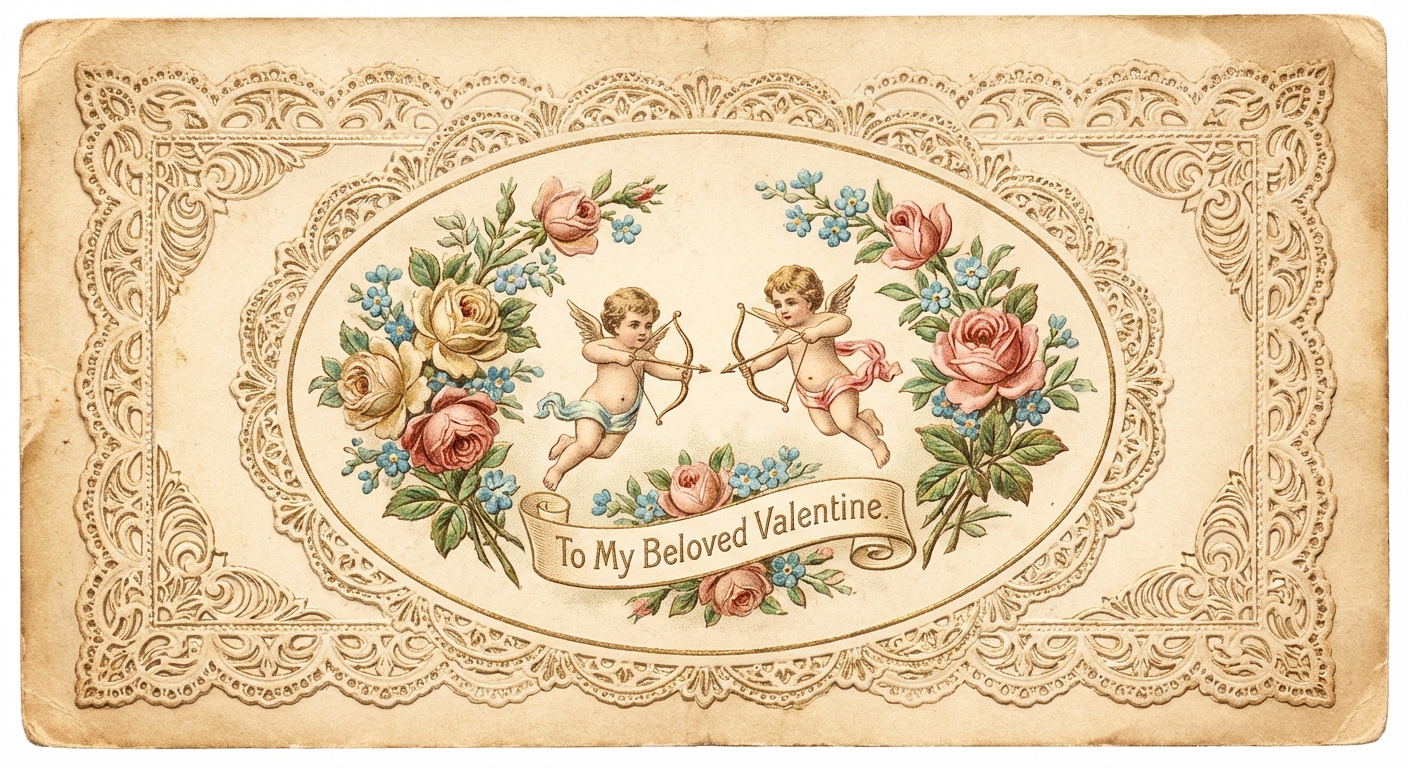
The first printed valentine appeared in London in 1797. By the 1700s and 1800s, Europeans were exchanging elaborate handmade cards decorated with lace, ribbons, and illustrations. The tradition was well established long before industrial production took over.
The Victorian revolution: how cards became big business
Everything changed in 1840 with the introduction of the Penny Post in Britain. Before this, sending mail was expensive. After, it cost just one penny to send a letter anywhere in the country.
The impact was immediate. In 1835, approximately 60,000 Valentine’s cards were sent by post in Britain. By 1840, that number had skyrocketed to over 400,000. The economics of Valentine’s Day had shifted entirely.
Across the Atlantic, a young woman named Esther Howland saw an opportunity. In 1847, Howland received an elaborate English valentine and was captivated by its quality. Her father owned a stationery business in Worcester, Massachusetts, and she convinced him to import the materials she needed to create American versions.
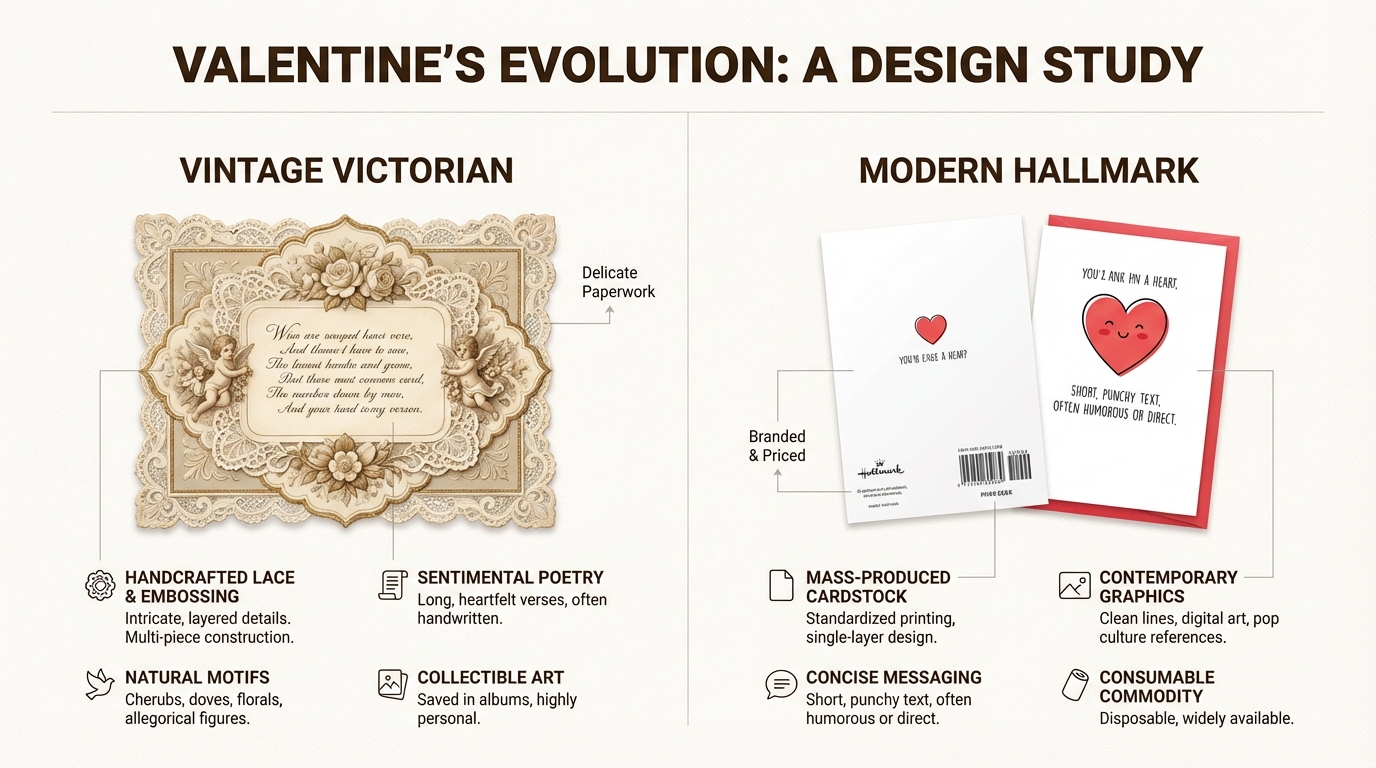
Howland’s cards were revolutionary. She used an assembly line of local women (whom she paid above-average wages) to create intricate designs featuring imported lace, embossed paper, and detailed illustrations. Her New England Valentine Company operated out of her home until the mid-1870s, when she moved production to a factory.
At her peak, Howland was selling $100,000 worth of valentines annually. That’s roughly $3 million in today’s money. Her most elaborate cards cost $35 each, a fortune at the time. She earned the title “Mother of the American Valentine,” and her success proved there was serious money in romantic stationery.
There was some controversy about who was first. Jotham Taft of Grafton, Massachusetts, may have started producing valentines as early as 1840, and his family disputed Howland’s claim to primacy. Taft may even have been Howland’s mentor. But history remembers Howland, perhaps because she built the bigger business.
In 1881, George C. Whitney bought out Howland’s company along with nine competitors, consolidating the industry. Whitney transitioned production from handmade assembly lines to machine manufacturing, making cards more affordable and accessible.
At Johnsons Cards, we understand the balance between craftsmanship and scalability that Howland pioneered. Our digital printing for short runs lets independent creators achieve gallery-quality results without massive minimum orders, while our litho printing for longer runs handles high-volume production with the same attention to detail.
Hallmark and the 20th century: popularisers, not inventors
Hallmark entered the Valentine’s Day business in 1913, when Hall Bros. (as the company was then called) sold its first Valentine’s cards. They began producing their own designs in 1916. By the mid-20th century, “Hallmark” had become synonymous with greeting cards for many Americans.
But Hallmark didn’t invent Valentine’s Day. They didn’t even invent the Valentine’s card. What they did was scale it. Hallmark made high-quality, affordable valentines available in every corner shop and supermarket. They shaped modern aesthetics, created new designs for changing tastes, and turned a regional tradition into a national phenomenon.
The distinction matters. As UNLV history professor Elizabeth Nelson notes, “Hallmark has been influential in shaping the aesthetics of the valentine in the twentieth century and creating new valentines to appeal to modern celebrants.” They capitalised on existing demand, they didn’t manufacture it.
Today’s numbers are staggering. The Greeting Card Association estimates 145 million Valentine’s cards are exchanged annually in the US, making it the second most popular card-sending occasion after Christmas (which sees about 1.6 billion cards). When you add in classroom valentine packs, the total pushes past a billion.
What this means for card creators today
The Valentine’s Day story offers a few lessons for anyone in the greeting card business today.
First, tradition matters. People have been exchanging romantic notes on 14 February for over 600 years. That’s not a manufactured tradition, it’s a genuine cultural practice. When you create Valentine’s cards, you’re participating in something with real historical weight.
Second, quality stands out. Esther Howland succeeded because her cards were visibly superior to the competition. In an age of mass production, craftsmanship still differentiates. Whether it’s special finishes like embossing and foil blocking or simply superior paper stock, quality gets noticed.
Third, there’s room for independents. Howland started in her home with a dozen prototypes. Whitney consolidated the industry, but he didn’t eliminate competition. Today’s market supports everything from mass-produced supermarket cards to boutique handmade designs.
For independent artists and small publishers, Valentine’s Day represents a significant opportunity. The market is proven, the demand is consistent, and consumers are increasingly interested in unique, high-quality alternatives to mass-market offerings.
At Johnsons Cards, we work with artists and photographers to transform their designs into retail-ready products. Our personal service means you get expert guidance on everything from paper selection to finishing techniques.
Create your own Valentine’s Day card legacy
So did greeting card companies invent Valentine’s Day? Absolutely not. The holiday evolved over centuries from Roman festivals, medieval poetry, and Victorian entrepreneurship. Chaucer made it romantic in 1382. The Duke of Orleans wrote the first valentine in 1415. Esther Howland built an empire on it in 1849. Hallmark scaled it in 1913.
The greeting card industry didn’t create the tradition. They recognised it, amplified it, and made it accessible. But the desire to express affection on 14 February? That’s been around for over half a millennium.
For modern card creators, this is good news. You’re not manufacturing demand for a fake holiday. You’re contributing to a genuine cultural tradition with deep roots. Whether you’re designing intricate lace-cut valentines in the Victorian tradition or creating minimalist modern designs, you’re part of a long lineage.
Quality printing brings your vision to life. From embossing and debossing to foil blocking and white ink printing, the right finishes can elevate your designs from good to exceptional.
Get in touch to discuss your greeting card project, or view our price list to see how accessible professional printing can be. With nearly 200 years of heritage in greeting card printing, we understand what it takes to create cards that people want to give and keep.
Frequently Asked Questions
Did greeting card companies invent Valentine’s Day?
No. Valentine’s Day has roots dating back to ancient Roman times and the early Christian church. The romantic associations developed in the 14th century through Geoffrey Chaucer’s poetry, centuries before commercial greeting cards existed. Card companies popularised and commercialised the holiday, but they didn’t create it.
When did Valentine’s Day become associated with greeting cards?
The exchange of handmade valentines began in the 15th century, with the oldest surviving example written by Charles, Duke of Orleans in 1415. Commercial production started in the late 1700s, and mass production began in the 1840s with pioneers like Esther Howland in America.
Who invented the Valentine’s Day card?
There’s no single inventor. The tradition evolved gradually from handwritten love notes in the 15th century to printed cards in the late 1700s. Esther Howland is known as the ‘Mother of the American Valentine’ for popularising mass-produced valentines in the United States starting in 1849.
Is Valentine’s Day just a commercial holiday?
While Valentine’s Day is heavily commercialised today, its origins are genuine and centuries old. The commercialisation accelerated in the Victorian era with affordable postage and mass production, but the romantic tradition predates commerce by hundreds of years.
How many Valentine’s cards are sold each year?
Approximately 145 million Valentine’s cards are exchanged annually in the United States, making it the second most popular card-sending holiday after Christmas (1.6 billion cards). In the UK, around 140 million Valentine’s cards are purchased each year.
What is the oldest known Valentine’s Day card?
The oldest surviving romantic valentine was written in 1415 by Charles, Duke of Orleans, to his wife while he was imprisoned in the Tower of London. The poem, written in French, is now held in the British Library. His wife died before receiving it.
Did Hallmark invent Valentine’s Day?
No. Hallmark sold its first Valentine’s cards in 1913, began producing original designs in 1916, and helped popularise the holiday in the 20th century. However, Valentine’s Day had been celebrated for centuries before Hallmark existed, and commercial valentines had been produced since the 1840s.